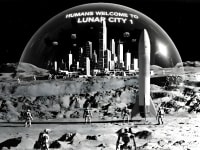
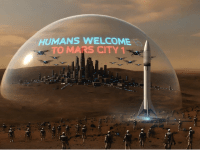
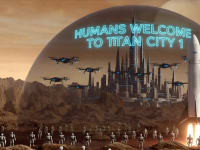
Goal: Establish a space and multi-planetary exclusively robotic workforce system to construct self-sustaining interplanetary space stations and Moon - Mars - Titan planetary colonies, prior to human arrival.
Impact: Mitigate deep-space hazards and disasters by utilizing Earth-based, distributed human operators to manage infrastructure building remotely.
Approach: Transforms planetary colonization into an automated, Earth-supervised logistics and production pipeline scalable to the Moon, Mars, Titan, and extreme terrestrial environments.
The following suggested organizational and technical proposals are a part of a recommended universal long-term strategy, adapted by Humanity, on the use of robotics for space and planetary exploration (space, Lunar, Mars, Titan), but can be also utilized on specific Earth applications, such as Deep-sea and Antarctica exploration, large-scale natural or artificial disasters recovery etc.
The proposed strategy/system is based on the current and near future technology on robotics and autonomy, human factors analysis, space exploration lessons learned, vast but predictable resources (a humanity’s universal effort), capability for higher risk operations.
The strategy/system envisions a future of a fully robotic space and planetary exploration, research, manufacturing and maintenance, with humans act only as Earth-based direct expert controllers or supervisors of semi-autonomous robotic systems, not as space travelers for the next decades to come.
When specific conditions and standards are met, humans will be able to directly act as colonizers, safe to travel to their already established intermediate space stations and planetary colonies constructed by the Pioneer Planetary Robotic Workforce in the Sol system.
The proposed System-of-Systems includes a universal Earth-based human standard workforce (e.g. employees and mission experts) and an extra volunteer workforce (e.g. students, hobbyists), working at specific shifts and on dynamic project work packages to counter the command and control signal latency issues and the project’s high to low complexity problems; a capable industrial supply chain and a continuous production line of universally standardized rockets, satellites, landing craft, robotic heavy vehicles and humanoid robotic workers (acting also as human factors test platforms); technically standardized and controlled materials and vehicle and robotic replaceable/reusable/traceable parts and assemblies, sensors, tools, energy sources; robotic components and systems capable for on-site maintenance by other common type robots; and technical and quality and logistics management procedures, at a universal level.
After many decades of robotic work, exploration, accidents investigation, manufacturing of human life support cities and infrastructures on Luna, Mars, Titan and the interplanetary space, as well as the future discovery of solutions on artificial gravity, creation of artificial small-scale earth-like environments in planets or space stations, relevant human health and safety issues, finally, Humanity supported by the Pioneer Planetary Robotic Workforce will be able to perform survivable and sustainable space travels and planetary colonization operations, and live efficiently on other planets/moons, in large numbers inside artificial self-sustained comfortable and safe cities (large numbers of colonists are expected to provide the necessary social and psychological benefits for a society to function harmonically).
Like this entry?
-
About the Entrant
- Name:P Katsoudas
- Type of entry:individual
- Profession:
- P's hobbies and activities:ASDindustry,airworthiness,mechatronics,astronomy
- P is inspired by:ASD industry trends and products
- Patent status:none