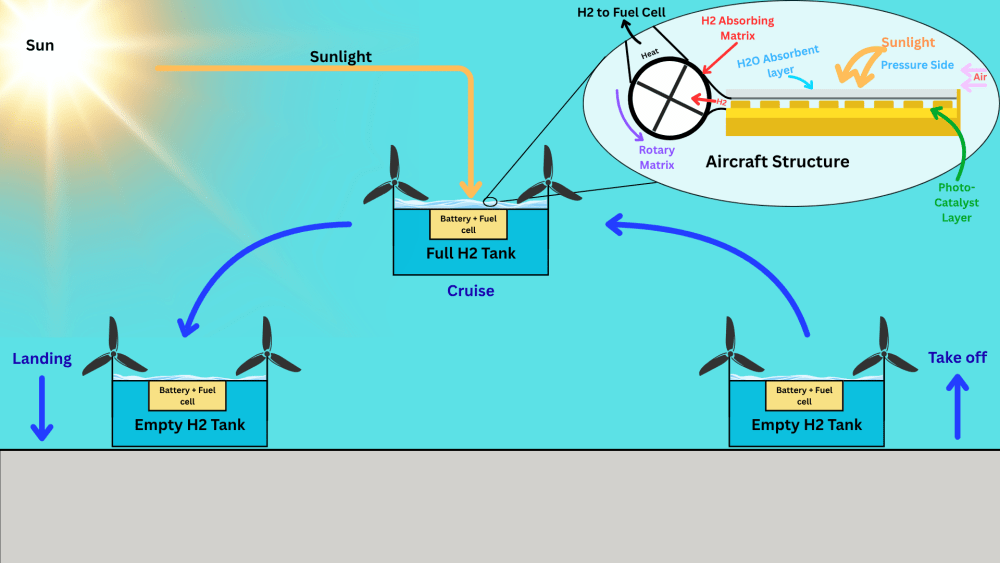
Electric aircraft's growth is hampered by today's limited battery technology. Very low power density means heavy pack of battery to meet the power demand and required range. In traditional aircraft fuel is consumed which continuously makes the aircraft lighter in flight and during landing. This is not possible in electric aircraft as a depleted battery still remains as a dead weight. Consequently such aircraft design is complicated and of limited range. The industry must focus on efficient ways of resolving the battery weight problems. This design idea solves the problem of unwanted battery weight.
Implementation of this solution will make an electric aircraft fly lighter, longer with a less complicated system design. The operation will suddenly become more attractive to the emerging operators.
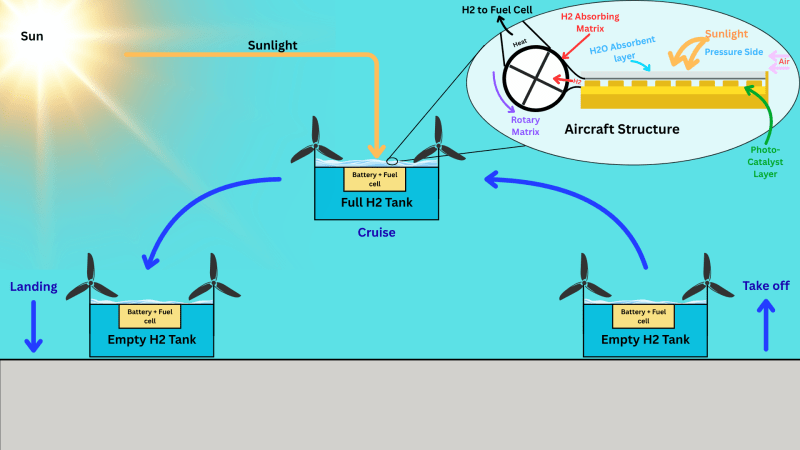
The conceived system has a bare minimum small battery and a tank to store hydrogen in transit. In the take off phase the tank remains empty and the battery powers it. In cruise the onboard Hydrogen Generator (cross section shown in the zoomed portion of the illustration) kicks in. It is a unique arrangement that utilizes atmospheric water vapor and sunlight to produce hydrogen in flight. The generated hydrogen can directly power a fuel cell and store a small portion for margin of safety. The pressured outer surfaces of the aircraft are first coated with efficient photocatalysts (lego brick like protruded portion in illustration). On top of it is a transparent layer that can absorb large volume of water vapor. Between these two layers is a thin channel. Sunlight passes through the first layer and activates the photocatalysts. Hydrogen is produced that flows through the thin channel to a gradually enlarging duct, to finally a hydrogen absorbent matrix, i.e. a rotary cylinder of four separated quadrants. Once a quadrant of the rotary matrix has absorbed enough gas, it is rotated such that the quadrant now aligns with a heating duct and the adjacent quadrant takes its left out place. On demand the heating duct heats the matrix using waste heat to release hydrogen for use. The entire rotary matrix can be inside the storage tank space. The aircraft lands with a near empty tank.
Removal of battery dead weight using abundant sunlight and water vapor makes this solution novel. Sufficient water is present until 5 km altitude and the general electric aircraft operation is not expected to fly higher.
This is applicable to any electric aircraft propulsion and even for conventional aircraft to provide electrical power.
Thousands of electric aircraft are to fly in a decade and grow further. An enabling technology like this can encompass the entire market.
The highest order of manufacturing core competency are: broadband photocatalysts, water absorbent, hydrogen adsorbent. The rest of the system can be manufactured using standard aircraft and mechanical engineering.
Special materials are likely to cost high in the early days of application but that should gradually come down as the volume increases. The benefits will outweigh the cost implications.
Like this entry?
-
About the Entrant
- Name:Proloy Jyoti Naskar
- Type of entry:individual
- Profession:
- Proloy Jyoti's hobbies and activities:Inventor
- Proloy Jyoti belongs to these online communities:LinkedIn
- Proloy Jyoti is inspired by:Necessities of life
- Software used for this entry:No
- Patent status:none