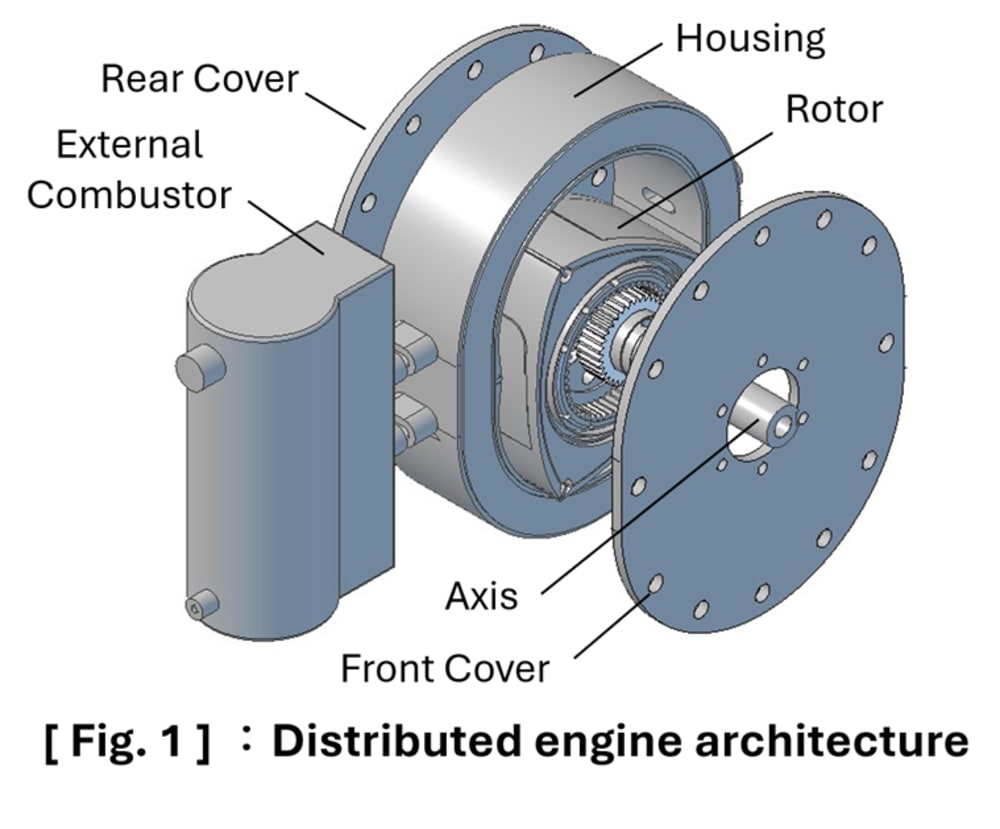
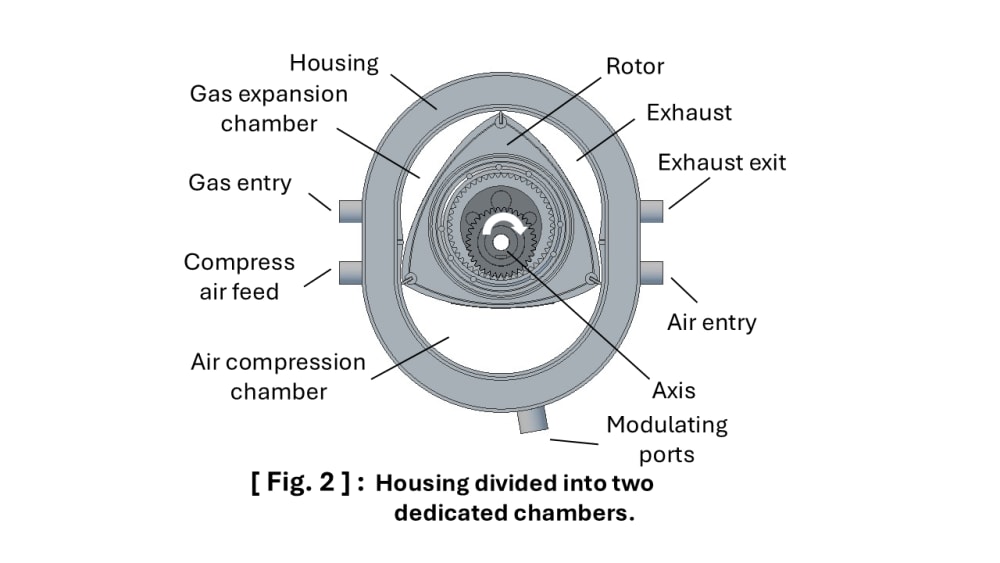
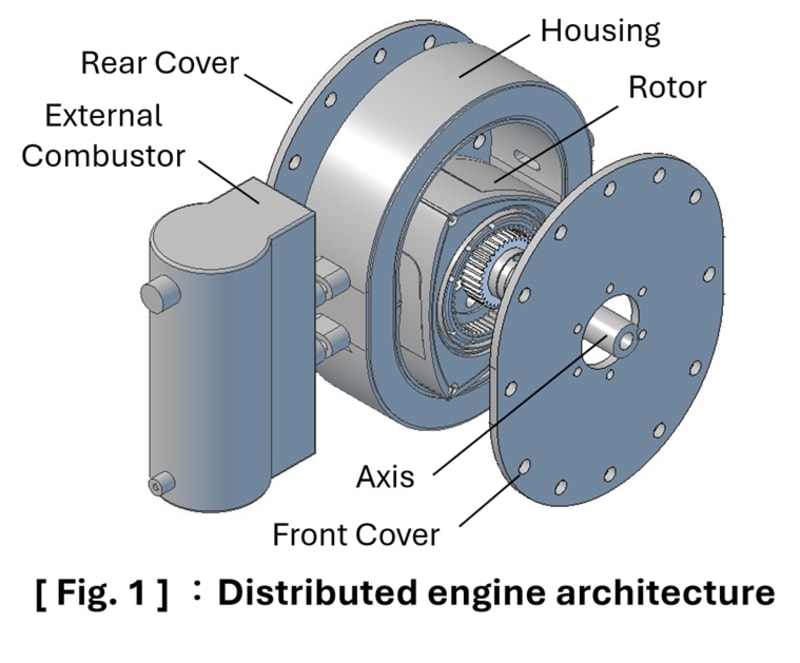
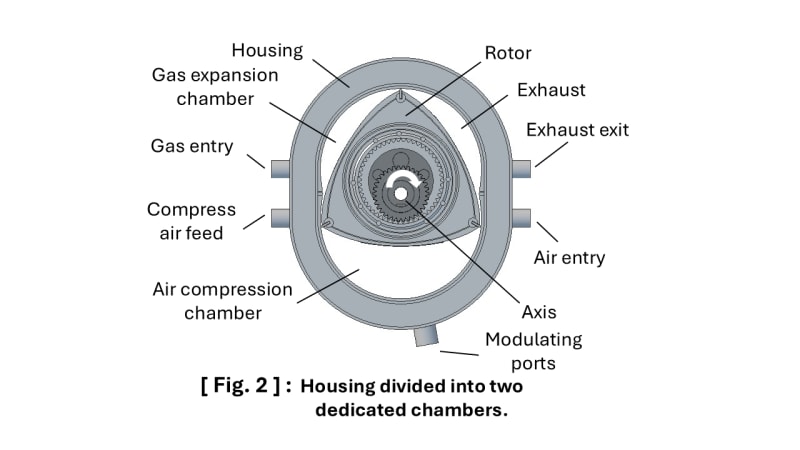
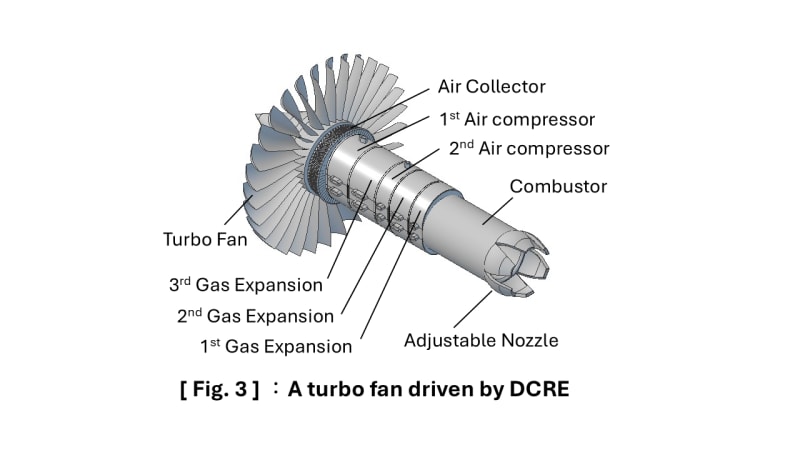


To eliminate the issues of incomplete combustion, high fuel consumption, and high emissions inherent in the Wankel engine's elongated combustion chamber, this Digitally Controlled Rotary Engine (DCRE) introduces an external combustion chamber. By pairing it with air compression and expansion chambers that mimic Wankel geometry, it creates an entirely new hybrid engine design (see Fig.1, 2). Because compression, combustion, and expansion operate in separate, dedicated zones, the engine can instantly adjust its power output by digitally regulating the intake compression ratio.
Fuel possesses an energy density 50 times greater than that of lithium batteries. The DCRE simultaneously retains this high energy density trait — making it suitable for long-distance, heavy-payload transport — while delivering the fast power output adjustment capabilities of an electric motor. This combination makes it exceptionally well-suited as a propulsion system for adjusting the attitude of Vertical Take-Off and Landing (VTOL) aircraft.
Innovations:
-
Continuous Combustion via External Combustor featuring an independent burner for stable, continuous combustion. With no moving parts in the chamber, the burning process remains completely free from mechanical disruption.
-
Functional Separation, DCRE reconfigures the Wankel engine cylinder into two distinct sections—compression and expansion—allowing each function to be individually optimized (see Fig. 2). Electromagnetic valves used for intake control regulate the air compression ratio (which dictates the output power). Assuming a main shaft speed of 3,600 RPM, the theoretical output response time falls roughly between 20 to 50 milliseconds (pending physical prototype verification).
-
Rotation Replacing Reciprocation.
Technical Advantages:
- Expansion Ratio > Compression Ratio.
- A hybrid thermodynamic architecture combining elements of the Atkinson and Brayton cycles.
- Employs quasi-polytropic expansion.
- Impact: Theoretical efficiency can surpass that of diesel engines.
Disruptive Cost Structure:
- Only two primary moving parts.
- Drops the manufacturing cost structure down a whole level.
Multi-Fuel Capabilities:
- Hydrogen energy.
- Biofuels.
- Synthetic fuels and others.
Digital-Grade Dynamic Response:
- Digitally controlled electromagnetic valves manage the compression ratio.
- Instantaneous power output adjustments.
- Impact: Achieves a control profile closely approaching that of an electric motor.
Market Demand: Filling a Massive Gap:
This technology targets the critical market sector where "electric powertrains cannot perform, yet low emissions and long range / heavy payload are strictly required."
High-Value Applications:
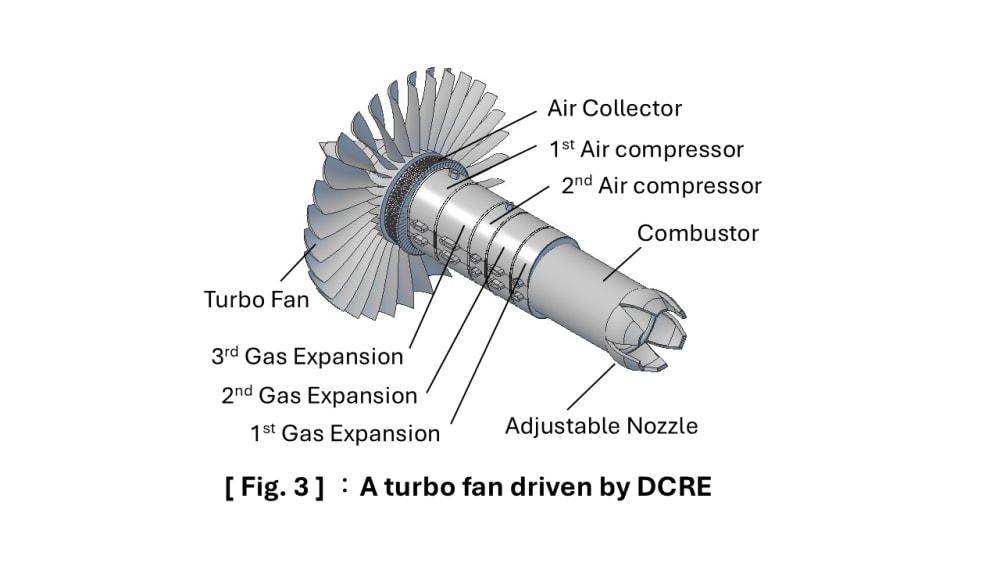
- No reduction gearbox required: The main shaft speed runs between 3,000 to 5,000 RPM, matching perfectly with aviation turbofan speeds.
- Direct high-speed power output.
- Ultra-fast dynamic response.
- Multi-cylinder series connection towards high thermal efficiency, Diesel engine replacement.
- Lowered fuel costs.
- Fuel diversification.
- Electric Vehicle (EV) range extenders.
- Microgrids, robotics, drones, and portable power units.
Like this entry?
-
About the Entrant
- Name:Kan Cheng
- Type of entry:individual
- Profession:
- Number of times previously entering contest:2
- Kan's favorite design and analysis tools:Alibre cad tool
- Kan's hobbies and activities:Thermal dynamics study
- Kan belongs to these online communities:line
- Kan is inspired by:1. A sustainable environment for future generations.
2. Future powertrain.
3. Green energy. - Software used for this entry:None
- Patent status:pending