Congratulations to Our 2026 Grand Prize and First Place Winners!
GenesisTissue’s Regenerative Breast Tissue (RBT), a 3D-bioprinted scaffold that offers a natural alternative to silicone implants for breast cancer patients, was named the $25,000 grand prize winner at a live finalist round held November 6. RBT supports the patient’s own transferred fat as it grows, then gradually dissolves, resulting in fully natural tissue. This could greatly improve outcomes in breast reconstruction and augmentation, and give lumpectomy patients a reconstruction option for the first time.
Click here for the full list of winners. Also see the Top 100 highest scoring entries. Special thanks to our esteemed panel of judges.
Help build a better tomorrow
Since Tech Briefs magazine launched the Create the Future Design contest in 2002 to recognize and reward engineering innovation, over 16,000 design ideas have been submitted by engineers, students, and entrepreneurs in more than 100 countries. Join the innovators who dared to dream big by entering your ideas in our 2026 contest.
Read About All the 2025 Winning Inventions

Special Report spotlights the eight amazing winners in 2025 as well as honorable mentions in each category, plus the top ten most popular entries as voted by our community.
Click here to read moreThank you from our Sponsors
“At COMSOL, we are very excited to recognize innovators and their important work this year. We are grateful for the opportunity to support the Create the Future Design Contest, which is an excellent platform for designers to showcase their ideas and products in front of a worldwide audience. Best of luck to all participants!”
— Bernt Nilsson, Senior Vice President of Marketing, COMSOL, Inc.
“From our beginnings, Mouser has supported engineers, innovators and students. We are proud of our longstanding support for the Create the Future Design Contest and the many innovations it has inspired.”
— Kevin Hess, Senior Vice President of Marketing, Mouser Electronics
contest
Contest

Blue Spirit Aero (BSA) is developing the Dragonfly family, a new generation of hydrogen-electric aircraft designed specifically for pilot training, general aviation and military operations.
The project addresses a major challenge facing the aviation industry. The global flight training fleet is aging rapidly, with an average aircraft age of around 47 years.
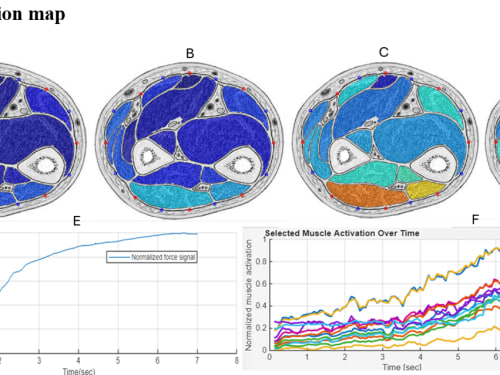

Which input signals to an engine control unit can affect the emissions of the car? Do I have an OBDII diagnosis in place for them? Which variables must be added to a measurement setup to properly analyze a system failure? What is the technical impact of removing a specific software component,


We don't build new cities. We upgrade the infrastructure cities already have. The next energy transition will not happen on empty land -- it will happen where people already park every day. We're transforming the world's largest unused energy infrastructure -- parking lots.
The image demonstrates how conventional parking infrastructure can evolve into attractive, human-centered public spaces.

There are many senior citizens who are living alone in houses or apartments. They usually lock the main door from the inside for their own security.
I have known several cases of senior citizens having a fall at night inside an apartment. This fall might result in an injury. Even otherwise, some senior citizens,
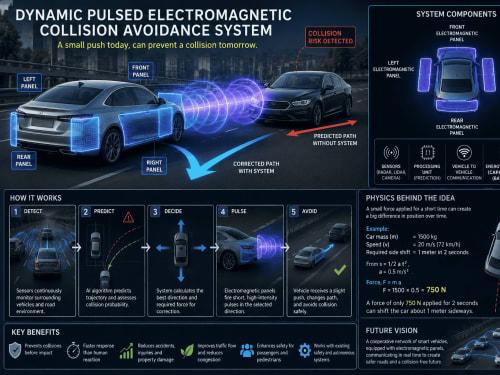
The Dynamic Pulsed Electromagnetic Collision Avoidance System is an innovative vehicle safety concept designed to reduce road accidents by preventing collisions before they occur. Unlike conventional safety technologies that mainly rely on warning drivers or applying emergency brakes, this system aims to actively alter the trajectory of a vehicle using controlled electromagnetic pulses.
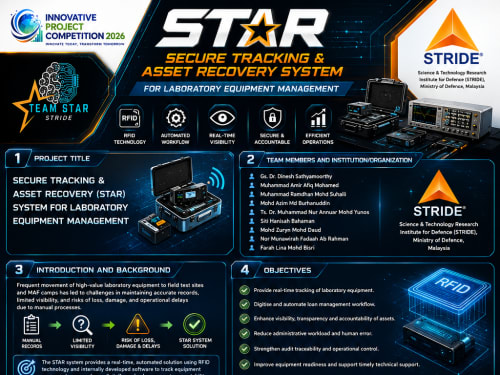
The Secure Tracking & Asset Recovery (STAR) system, developed by the Science & Technology Research Institute for Defence (STRIDE), is an innovative real-time laboratory asset monitoring solution designed to overcome the vulnerabilities of manual equipment tracking in high-stakes research and testing environments.
When high-value equipment is frequently deployed to field test sites and military camps,

A three-layer holon concept is a compelling way to think about future transport as a stacked mobility architecture rather than a set of isolated vehicles that are capable of self-management, interoperable with the layers above and below.
Layer 1 is the urban, suburban, and intercity zero-emission VTOL layer. This layer would handle short trips,
Page 16 of 1074