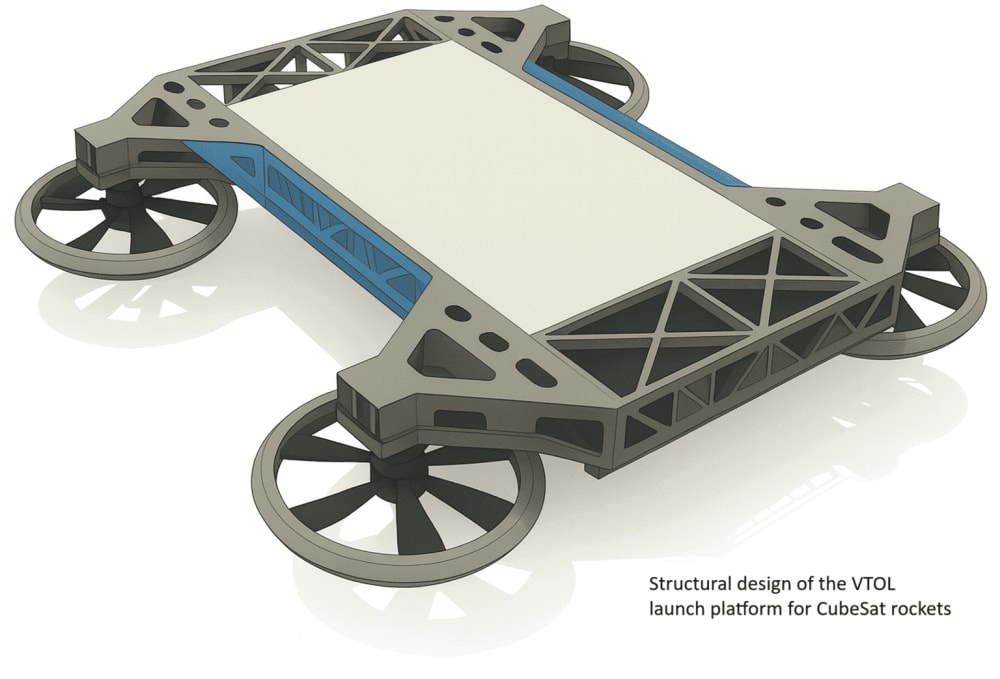

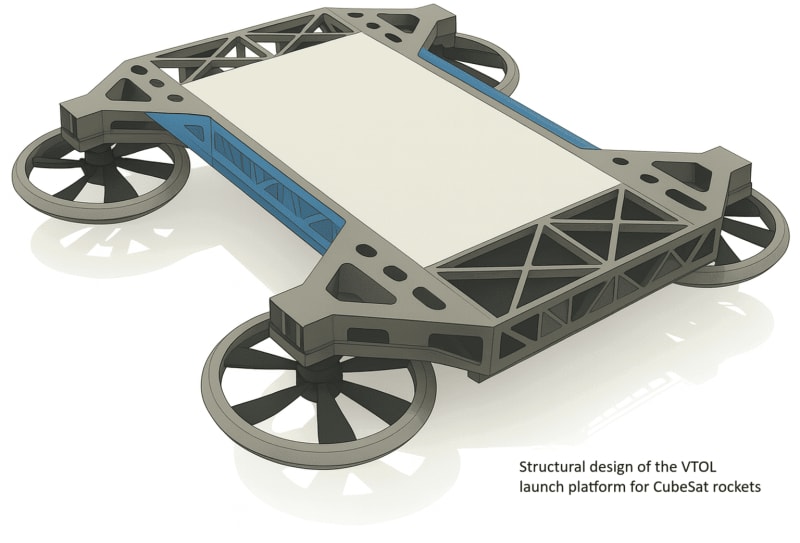


This project introduces a reusable aerial launch platform powered by hydrogen fuel cells, designed to transport and deploy up to three micro-rockets from altitudes of 30 to 40 kilometers. It provides an innovative alternative to traditional ground-based launches, enabling more affordable and flexible access to space—especially for lightweight payloads like CubeSats.
The system consists of a lightweight rectangular frame equipped with six high-thrust drone motors. It carries three small-scale launch bays, each hosting a CubeSat-class rocket. Upon reaching the desired altitude, the rockets are repositioned into vertical alignment by a mechanical arm and launched conventionally, igniting their own propulsion systems from a high-altitude release point.
A functional version 1 prototype has already been built using PLA and drone motors, successfully demonstrating lift, flight control, stabilization, and mock deployment. The final version is designed to be built with aerospace-grade aluminum or carbon fiber for long-term durability and reusability. Components exposed to rocket exhaust are modular for easy replacement.
The platform is powered by hydrogen fuel cells, offering significantly lower energy costs and a cleaner environmental footprint compared to traditional rocket fuels. Flight autonomy covers lift-off, repositioning, and launch phases. For extended operations, a swarm of auxiliary drones can exchange hydrogen cartridges mid-air, allowing continuous operation without landing.
Key advantages include:
- Fuel and manufacturing savings: Launching from the stratosphere reduces the amount of fuel required by each rocket, cutting costs significantly. Additionally, rockets can be redesigned to be smaller and lighter, further reducing material and fabrication expenses.
- Mobility and flexibility: The platform can relocate to optimal latitudes (e.g., near the equator) and launch from regions with favorable weather, improving orbital insertion efficiency and reducing launch delays.
- Scalable and autonomous: Onboard AI manages stabilization, navigation, emergency handling, and launch sequencing. Remote supervision from ground stations is also supported.
- Lower environmental and acoustic impact: Hydrogen-powered VTOL launch avoids carbon emissions and reduces noise pollution compared to terrestrial rocket launches.
- Global accessibility: This system democratizes access to space by allowing orbital deployment from airspace, bypassing the need for fixed terrestrial infrastructure.
This innovation reimagines launch infrastructure as lightweight, clean, mobile, and reusable. It offers a cost-effective, flexible, and environmentally responsible approach to deploying satellites, responding to the global rise in demand for small payload launch solutions.
Like this entry?
-
About the Entrant
- Name:Rafael Atencio
- Type of entry:teamTeam members:
- Rafael Atencio
- Tatiana Mejia
- Paola Mejia
- Software used for this entry:SolidWorks
- Patent status:pending