Congratulations to Our 2025 Grand Prize and First Place Winners!
Imersiv, a breakthrough technology that improves audio performance by 100X compared to today’s very best audio equipment for applications ranging from sound engineering to space missions to medical imaging, was named the $25,000 grand prize winner at a live finalist round held November 7 in New York. Click here for the full list of winners. Also see the Top 100 highest scoring entries. Special thanks to our esteemed panel of judges.
Help build a better tomorrow
Since Tech Briefs magazine launched the Create the Future Design contest in 2002 to recognize and reward engineering innovation, over 16,000 design ideas have been submitted by engineers, students, and entrepreneurs in more than 100 countries. Join the innovators who dared to dream big by entering your ideas in our 2026 contest opening March 1.
Read About All the 2024 Winning Inventions
Special Report spotlights the eight amazing winners in 2024 as well as honorable mentions in each category, plus the top ten most popular entries as voted by our community.
Click here to read moreA ‘Create the Future’ Winner Featured on ‘Here’s an Idea’
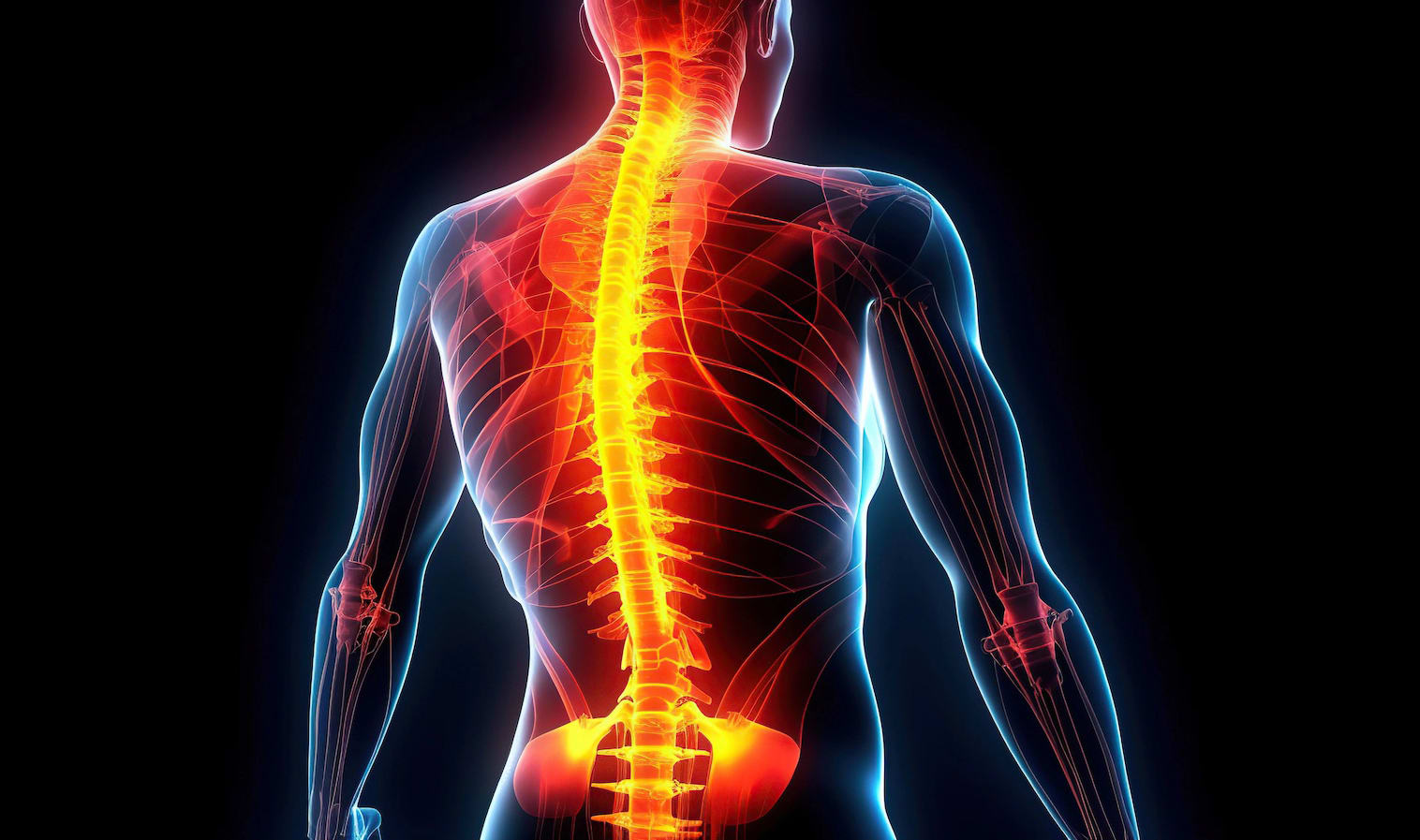
Spinal cord injury affects 17,000 Americans and 700,000 people worldwide each year. A research team at NeuroPair, Inc. won the Grand Prize in the 2023 Create the Future Design Contest for a revolutionary approach to spinal cord repair. In this Here’s an Idea podcast episode, Dr. Johannes Dapprich, NeuroPair’s CEO and founder, discusses their groundbreaking approach that addresses a critical need in the medical field, offering a fast and minimally invasive solution to a long-standing problem.
Listen nowThank you from our Sponsors
“At COMSOL, we are very excited to recognize innovators and their important work this year. We are grateful for the opportunity to support the Create the Future Design Contest, which is an excellent platform for designers to showcase their ideas and products in front of a worldwide audience. Best of luck to all participants!”
— Bernt Nilsson, Senior Vice President of Marketing, COMSOL, Inc.
“From our beginnings, Mouser has supported engineers, innovators and students. We are proud of our longstanding support for the Create the Future Design Contest and the many innovations it has inspired.”
— Kevin Hess, Senior Vice President of Marketing, Mouser Electronics
contest
Contest

This is video entertainmenr or advertising that can be viewed by commuters on a subway train while pasilng through a dark tunnel. The effect is similar to driving through an old covered wooden bridge and seeing the landscape through the gaps between the boards.
The images are streak scanned while looking through the moving train windows.
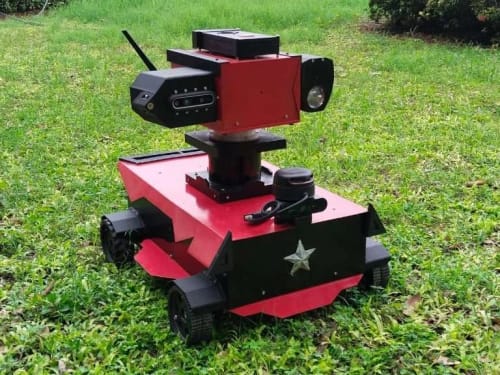
Autonomous Defense Robot for Threat Detection and Neutralization
This proposed idea introduces an advanced Autonomous Defense Robot aimed at meeting the urgent need for efficient, intelligent, and autonomous threat detection and neutralization, especially in high-security zones. The robot is designed to navigate, monitor, and respond to threats with high accuracy and agility, minimizing human intervention and risk.

This steering and guidance technique, for submarines, torpedos and other ships, is an outgrowth of a motion-based simulator theater. See
In the motion-based theater, propellers circulate water through mutually-perpendicular propulsion tubes to create back pressure to move the theater to pitch, roll and yaw (a trick reverse engineered from the human inner ear).

Rather than wasting sunlight on the roofs of movie theaters, the sun can be used as the light source for theater projectors.
The roof of the theater is fitted with a heliostat inside a cylindrical skylight.

Trains are found extensively throughout the world carrying Passengers and Freight. They are safe, economical and travel long distances in relative comfort for passengers. They are usually made strong and sturdy to withstand long usage and are heavy, weighing hundreds of tonnes. Since they travel on fixed rails,

SkyWay is a new mode of transportation intended to address all of the failures of today's surface transportation. Whether it's trains, or cars or buses; whether it's walking, cycling or running; it is "unsafe at any speed" on our roads and highways. Why? Humans are merely human. Mistakes happen. Streets are congested. People are in a hurry.

Despite rapid advances in drone technology, the instant, autonomous launch of multiple aerial missions remains a critical challenge. Current docking systems typically support only single-drone operations, limiting scalability and mission flexibility.
The Stackable Drone Docking Port addresses this challenge with a transformative solution. Designed as a compact, cylindrical docking station, it can house, charge,
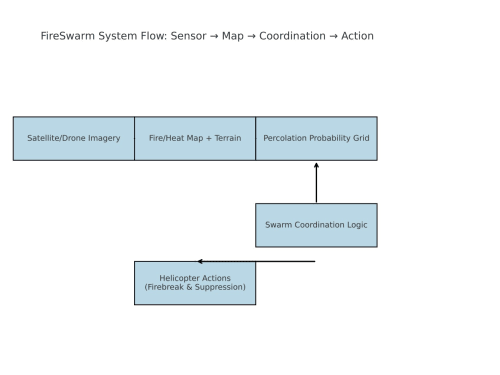
FireSwarm is an integrated aerial wildfire suppression system that combines thermodynamic innovation with swarm-based robotics to control and mitigate wildfires rapidly, safely, and precisely. The system leverages a two-phase deployment strategy using semi-autonomous helicopters to execute firebreak cutting and active flame suppression using thermally disruptive ice projectiles.

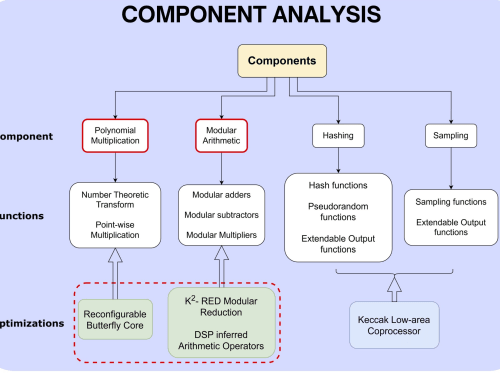
BACKGROUND
Rise of quantum computing threatens existing encryption schemes.
NIST has standardized Post‐Quantum Cryptography (PQC) algorithms.
A Quantum‐resistant Key Encapsulation Mechanism (KEM) based on the CRYSTALS‐Kyber algorithm was standardized as new Federal Information Processing Standards (FIPS).
Page 28 of 1029