2025
Entries
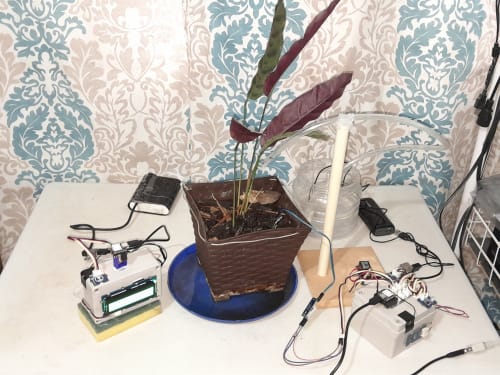
Using ESP-MESH network protocol is an innovative way to monitor my plants and provide them with water, both indoors and outdoors. ESP-MESH is a networking protocol built atop the Wi-Fi protocol,

As a lifelong reader, I was inspired by the book, “The Diamond Age” by Neal Stephenson. In the book, a very advanced AI embedded into an indestructible book helps a little girl overcome her circumstances. This is my conception of a similar idea using extrapolations of current technology in the fields of material science and very advanced manufacturing.

HAULER T20 (Patent Pending number BR102025006250) is equipment developed to reduce risks to people and processes, improving health and safety conditions in underground mining environments when compared to diesel-powered.
It is an important innovation because, in addition to its autonomous (driverless) operation, it features a side-turn bucket and a chassis-less design.

The idea is to have air outlets built onto the hand and foot areas of the spacesuit. The outlets are controlled by valves. The valves are controlled by the person wearing the suit. Movement is achieved by adjusting the valves as well as the hand and foot gestures.

The United States stands in stark contrast to other developed nations by the lack of affordable land travel. In the United States, 1 in 6 people has never left their home state, the cultural and political consequences of which are yet unrealized. Simultaneously,

This entry explains clearly how poor understanding is resulting in incorrect arrangement of propellers, causing serous VTOL Flight safety issues, and shows the solution to the problem.
I am going to discuss V–22 Osprey aircraft as the most prominent case pertaining to the issues above.
Overall V–22 Osprey is an outstanding engineering achievement, given the humble means,

This project introduces a reusable aerial launch platform powered by hydrogen fuel cells, designed to transport and deploy up to three micro-rockets from altitudes of 30 to 40 kilometers. It provides an innovative alternative to traditional ground-based launches, enabling more affordable and flexible access to space—especially for lightweight payloads like CubeSats.
Page 44 of 44